From raw data to results, in days not weeks.
Build bioinformatics pipelines on a visual canvas, run them on your own data, and see every step. No code, no waiting on a bioinformatician.
- RNA-seq.fastq .counts
- Variant calling.bam .vcf
- Proteomics.mzML
- Single-cell.h5ad
- ChIP-seq.bam .bed
- ATAC-seq.bam .narrowPeak
- Exome sequencing.bam .vcf
- Long-read sequencing.pod5 .bam
- Methylation.bam .bed
- 16S amplicon.fastq .biom
- Metagenomics.fastq .tsv
- Spatial transcriptomics.h5ad
- CRISPR screens.fastq .counts
- Small RNA-seq.fastq .counts
- Hi-C.cool
- Phylogenetics.fasta .nwk
The experiment takes a week. The analysis shouldn’t take a month.
Most labs generate data faster than anyone in the building can analyse it. The tools exist. What is missing is a way to use them without learning to program first.
About 3,000 steps
The tools your field already trusts, from read trimming to statistics, ready to connect.
No code to write
Build, run and change a pipeline from the canvas. No scripts, no environments.
Every run recorded
Versions, inputs and parameters kept with the result, so it runs again the same way.
Data in. Result out.
Four things happen between the sequencer and lab meeting. Scroll through them.
1
Drag in the steps you need
Pick from the library, or describe the experiment and let the assistant draft it. Steps only connect where the files fit, so a wiring mistake is not possible.
rnaseq-treated-vs-controlFASTQfastpSalmonDESeq2PlotStep library
fastpMultiQCSTARSalmonfeatureCountsDESeq2edgeRVolcano plotHeatmapRun logrnaseq-treated-vs-control4 of 4 steps done- fastp12/12 samples trimmed, 96.8% reads kept0:41
- salmon12/12 quantified, mapping rate 91.2%2:16
- deseq218,402 genes tested, 214 at padj < 0.053:02
- plotvolcano.svg written3:05
DESeq2 settings
- Design
- ~ batch + condition
- Contrast
- treated vs control
- Adjusted p
- < 0.05
- |log2 fold change|
- > 1
Treated vs control, 214 genes changed
2
Change a setting, not a script
Click a step and its settings open beside it: the threshold, the reference, the comparison you want to make. Each one says what it does.
rnaseq-treated-vs-controlFASTQfastpSalmonDESeq2PlotStep library
fastpMultiQCSTARSalmonfeatureCountsDESeq2edgeRVolcano plotHeatmapRun logrnaseq-treated-vs-control4 of 4 steps done- fastp12/12 samples trimmed, 96.8% reads kept0:41
- salmon12/12 quantified, mapping rate 91.2%2:16
- deseq218,402 genes tested, 214 at padj < 0.053:02
- plotvolcano.svg written3:05
DESeq2 settings
- Design
- ~ batch + condition
- Contrast
- treated vs control
- Adjusted p
- < 0.05
- |log2 fold change|
- > 1
Treated vs control, 214 genes changed
3
Press Run and watch it go
Every step runs on your own machine in its own environment, in order. Each one tells you when it is done, or exactly why it stopped.
rnaseq-treated-vs-controlFASTQfastpSalmonDESeq2PlotStep library
fastpMultiQCSTARSalmonfeatureCountsDESeq2edgeRVolcano plotHeatmapRun logrnaseq-treated-vs-control4 of 4 steps done- fastp12/12 samples trimmed, 96.8% reads kept0:41
- salmon12/12 quantified, mapping rate 91.2%2:16
- deseq218,402 genes tested, 214 at padj < 0.053:02
- plotvolcano.svg written3:05
DESeq2 settings
- Design
- ~ batch + condition
- Contrast
- treated vs control
- Adjusted p
- < 0.05
- |log2 fold change|
- > 1
Treated vs control, 214 genes changed
4
Read the result the same day
The figure is drawn from the last step’s output. The table behind every point is a click away, and it exports as SVG for the figure panel.
rnaseq-treated-vs-controlFASTQfastpSalmonDESeq2PlotStep library
fastpMultiQCSTARSalmonfeatureCountsDESeq2edgeRVolcano plotHeatmapRun logrnaseq-treated-vs-control4 of 4 steps done- fastp12/12 samples trimmed, 96.8% reads kept0:41
- salmon12/12 quantified, mapping rate 91.2%2:16
- deseq218,402 genes tested, 214 at padj < 0.053:02
- plotvolcano.svg written3:05
DESeq2 settings
- Design
- ~ batch + condition
- Contrast
- treated vs control
- Adjusted p
- < 0.05
- |log2 fold change|
- > 1
Treated vs control, 214 genes changed
Step library
- fastp12/12 samples trimmed, 96.8% reads kept0:41
- salmon12/12 quantified, mapping rate 91.2%2:16
- deseq218,402 genes tested, 214 at padj < 0.053:02
- plotvolcano.svg written3:05
DESeq2 settings
- Design
- ~ batch + condition
- Contrast
- treated vs control
- Adjusted p
- < 0.05
- |log2 fold change|
- > 1
Treated vs control, 214 genes changed
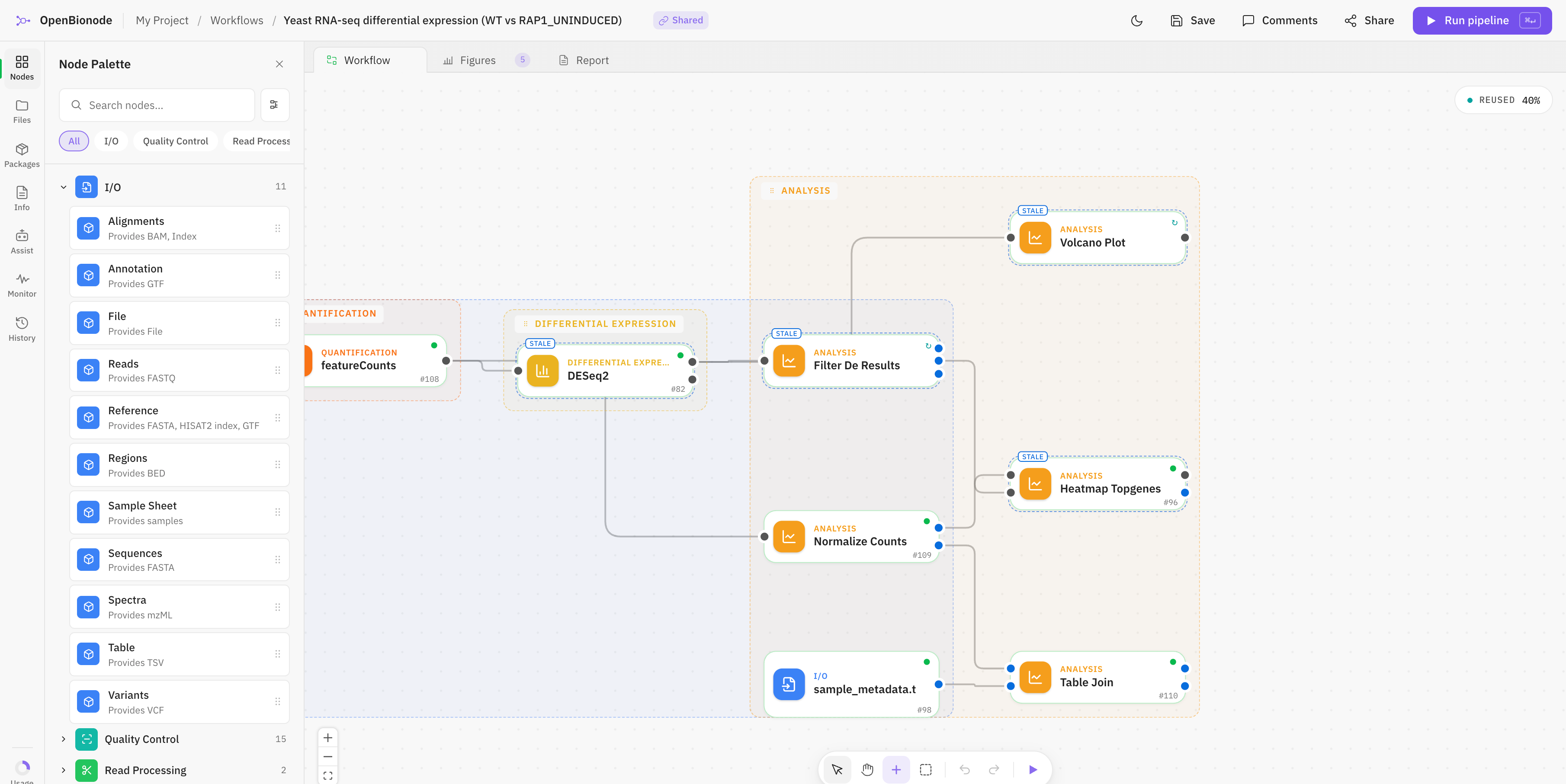
Change a setting. Not a script.
Parameters live in a panel. The code lives behind the node. Drop in the steps your field already trusts and connect them, rather than wiring them together in Bash.
- Around 3,000 steps, the same tools a core facility would run
- Set a threshold in a panel instead of editing a config file
- No conda environments, no cluster account, no job scripts
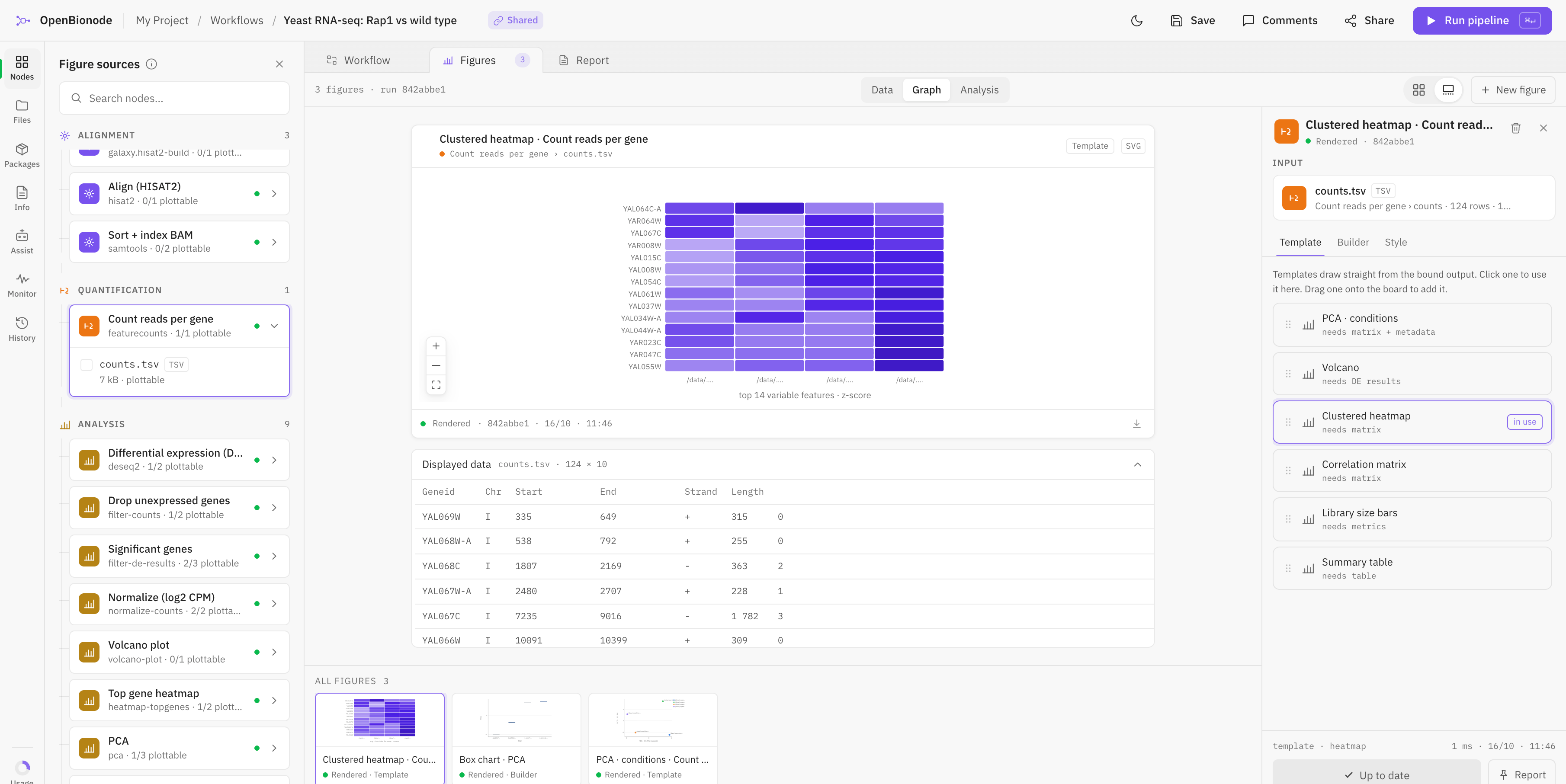
Read it yourself. Hand it to a colleague.
A run ends in plots and tables a colleague can rerun exactly, drawn from its own outputs, with the numbers behind each one a click away.
- Figure templates bind straight to a step’s output
- See the table a plot was drawn from, without leaving the page
- Export SVG for the figure panel, CSV for everything else
Describe it. Review it. Then run it.
Tell the assistant what the experiment was. It drafts the pipeline as steps on the canvas, not a thousand lines of code, so you can read every one before anything runs.
It never presses Run. You do.
Pick an example above, or describe your own. The draft appears here.
A preview on four starter pipelines. In the app the assistant drafts from your own description and data.
Built for the people waiting on the analysis.
Wet-lab scientists
Analyse your own data the day it comes off the sequencer, without waiting on anyone else’s week.
See pipelinesBioinformaticians
Build a pipeline once and hand it to the lab. Stop rerunning the same analysis for other people.
See pipelinesBiotech R&D
Shorten the loop from instrument to decision, with a record of every result behind it.
See pipelinesFrom the journal
All of the journalBring the analysis you’ve been waiting on.
OpenBionode is in early access. Tell us what you analyse and we’ll make sure the steps you need are ready when your seat opens.